There's a belief that runs deep in ad platforms: give advertisers too much targeting control, and they'll narrow their campaigns into nothing. Volume drops. Revenue drops. Everyone loses.
It sounds logical. It's also wrong, and it cost us years of revenue we left on the table.
This is the story of how we tested that assumption, what the data showed, and what it means for how platforms think about advertiser control.
The Fear Behind the Restriction
The feature in question was city and region-level geo-targeting. Standard in most platforms but in ours, it was throttled. Advertisers could target by country, but going deeper required a manual request to the account team, who would then toggle it on in the admin panel.
The internal logic went like this: if advertisers can target only New York or São Paulo instead of all of the USA or Brazil, they buy less inventory. Fewer impressions sold. Revenue drops. Sales bonuses drop.
So the feature stayed locked. For a decade.
What nobody calculated was the other side of that equation: advertisers who couldn't get the precision they needed were either running inefficient campaigns (wasting budget, getting frustrated) or leaving for platforms that gave them the control they wanted. We were selling suits with no option for alterations, then surprised that customers who needed a slim fit stopped coming back.
We were optimizing for short-term gross volume at the cost of advertiser lifetime value. And we didn't even know it.
Before Pushing for Change, We Validated the Demand
My instinct was that the restriction was hurting us. But instinct doesn't move decisions in product — data does.
I ran a structured survey across our active advertiser base. 15% responded — 270 advertisers out of ~1,800 active at the time. Completion rate: 89%. Not a vague "do you want more features" poll, but a specific one designed to answer three things: which verticals need geo-targeting, how often, and in which markets.
The results were unambiguous.
What verticals use region/city targeting?
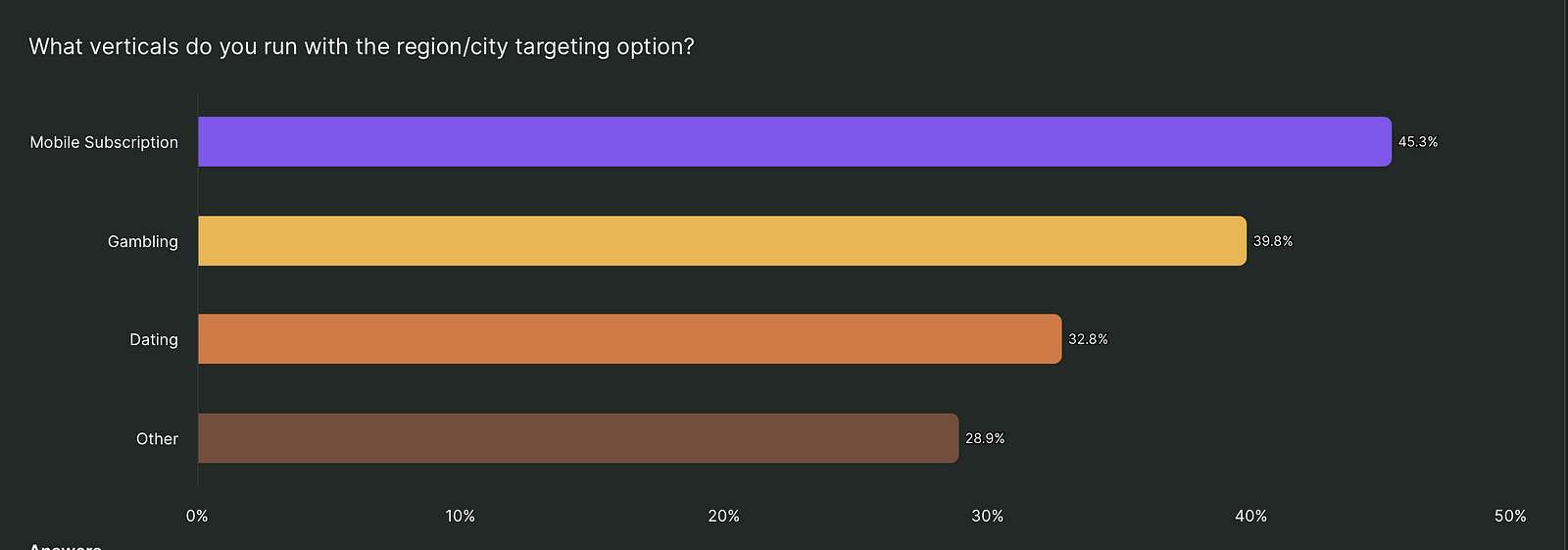
Mobile subscriptions led at 45.3%, followed by gambling at 39.8% and dating at 32.8%. This isn't surprising in hindsight. Mobile subscription conversion rates vary dramatically by carrier and region. Gambling operators have licensing constraints and legally cannot serve ads in certain jurisdictions. Dating works on proximity since nobody is swiping cross-country.
These weren't edge cases. These were our core revenue verticals.
How often do advertisers need it?
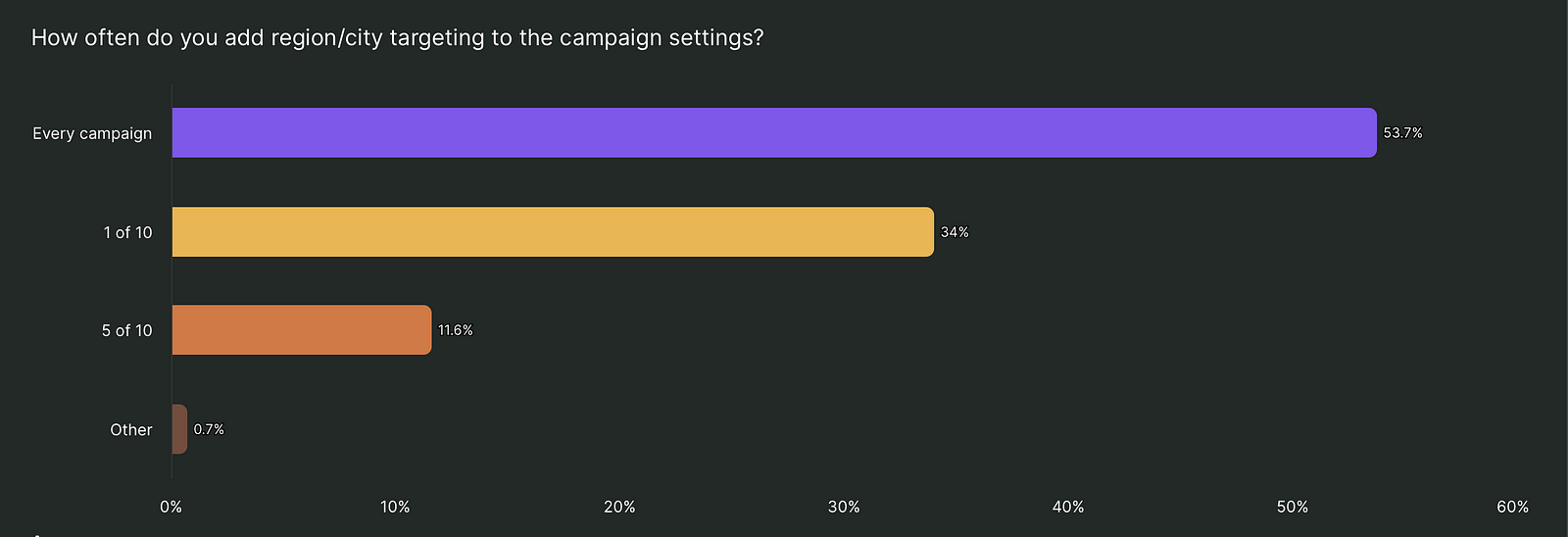
53.7% said they would use region/city targeting in every campaign. Another 34% said roughly 1 in 10. The "niche request" assumption was gone.
In which countries?
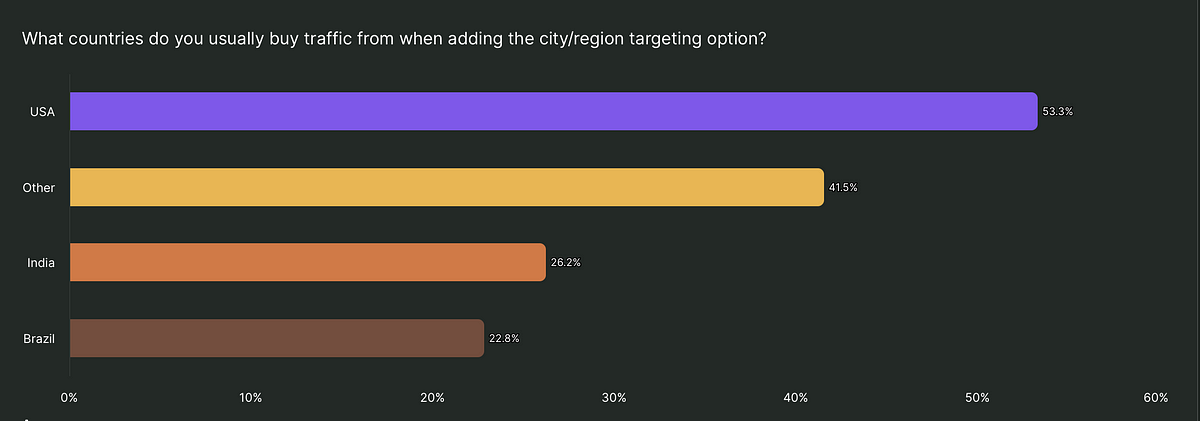
USA at 53.3%, India at 26.2%, Brazil at 22.8%. Exactly our highest-revenue markets. The demand was real, consistent, and concentrated where it mattered most.
What Actually Happens When You Give Advertisers Precision
We launched self-serve city and region targeting. Here's what we measured over the following three months.
eCPM increased by 32.5% on geo-targeted campaigns. The mechanism is straightforward: when an advertiser targets New York specifically, they compete with other advertisers who also want New York. Auction pressure goes up. Price per impression goes up. The inventory becomes more valuable, not less.
Campaign lifetime increased by 61.3%. Advertisers who got relevant traffic stopped pausing and restarting campaigns. They found what worked and stayed. The "narrow targeting = lower spend" assumption was backwards: precision made advertisers more committed, not less.
Campaign LTV grew by 270%. Not just how much an advertiser spent in one session, but how long they stayed and how much they were worth over time. We just stopped making advertisers work against the platform.
And the traffic that didn't fit anyone's geo-targeting parameters? It didn't disappear. It redistributed to other campaigns that were happy to take broad, untargeted inventory. The supply didn't shrink. It just got sorted better.
Overall impression volume held flat. But 30% of campaigns now ran longer and at higher eCPM — which meant the same inventory was generating more revenue per cycle.
The fear was that precision would reduce volume. What actually happened: precision increased value, and volume sorted itself out.
The Real Cost of Protecting Gross Volume
The instinct to protect impressions sold is understandable. It's a visible, trackable number. Revenue per day is easy to report on a Monday morning.
What's harder to track: the advertiser who quietly reduced their budget because campaigns weren't converting. The one who tested your platform for 30 days and didn't renew. The one who asked for city-level targeting, got told it's not available, and went to a competitor.
Those losses don't show up as a single line item. They accumulate slowly, in cohort data that nobody is watching closely enough.
Every platform has restrictions that were put in place to protect a short-term metric. Some of them are legitimate. Others are protecting an assumption that was never actually tested. The geo-targeting restriction had been passed down for ten years as received wisdom. It took one structured survey and three months of post-launch data to prove it wrong.
The question worth asking: which restrictions in your platform are based on real evidence, and which ones are based on logic that made sense to someone in 2015?
What This Means If You're Running an Ad Network or DSP
Advertiser control and platform revenue are not zero-sum. The framing of "if they buy less per campaign, we lose" ignores what happens to LTV, retention, and the quality signal that precision targeting sends to the auction.
The advertisers who want more control are usually your best advertisers. They're running performance campaigns, watching their numbers, optimizing. That's not a segment you want to train to go elsewhere.
Gross volume is a lagging indicator of platform health. A platform that forces advertisers into broad targeting will show strong impression numbers right up until the advertisers start churning. By then, the damage is done.
Unlocking control doesn't mean losing control. Self-serve geo-targeting didn't create chaos. It reduced manual work, cut errors that were costing us refunds, and gave advertisers a reason to run more campaigns. Campaign creation increased by 13.8% after the marketing push — about as clean a disproof of "they'll narrow everything to nothing" as you can get.
A Note on Execution
The data made the business case. Competitive analysis confirmed industry standard since every major DSP had this in self-serve. Risk assessment with the traffic team found no operational blockers.
The actual launch was straightforward because the technical infrastructure already existed. It just wasn't exposed to advertisers. We coordinated with marketing and sales on rollout, trained support, shipped it.
One thing we didn't anticipate: our geo database had gaps in less common regions. It hadn't been maintained systematically because the feature was rarely used. Core markets were fine. But as advertisers started targeting less popular geos, mismatches surfaced and had to be fixed in production on a case-by-case basis. Not a blocker — but a real cost that came from years of treating the feature as an edge case.
Three months later, the numbers above were the result.
The lesson I keep coming back to: the most valuable product decisions aren't always about building something new. Sometimes they're about finding what's already there and asking why it's been kept from the people who need it.